
I’m not going to spend three paragraphs telling you not to do this. If you’re reading an article about where to buy gonadorelin online, you’ve probably already decided you’re doing it. So let’s skip the lecture and get into what actually matters: what can hurt you, what can’t, and how to tilt the odds in your favor.
Here’s the thing about gonadorelin that most sales pages bury or skip entirely, and it’s the single fact that should shape every decision you make about this molecule: how you dose it can flip the outcome you’re going for into its exact opposite. That’s not marketing spin, that’s basic endocrinology, and I think it deserves to be front and center instead of a footnote.
The one fact that changes everything
Gonadorelin is a synthetic copy of GnRH, gonadotropin-releasing hormone, the signal your hypothalamus already sends in pulses to keep the whole reproductive axis running. Get the rhythm right and the pituitary keeps releasing LH and FSH, which keep the testes making testosterone and sperm. Get the rhythm wrong, meaning a flat, constant exposure instead of pulses, and the same molecule eventually does the opposite: it desensitizes the receptors and shuts the signal down.
Same drug. Same vial. Completely different outcome depending on timing.
I bring this up first because it reframes the whole safety question. With most gray-market peptides, the risk conversation is mostly about purity, is the powder what it says it is. With gonadorelin, purity is only half the story. Even a perfectly clean, perfectly dosed vial can work against you if nobody who understands the dosing schedule is involved. That’s not a reason to panic. It’s a reason to be precise about what “safe” actually needs to include here.
What the research actually shows, not what the sales copy implies
I looked at the actual studies before writing a word of this, because I don’t think it’s fair to talk risk without talking evidence.
The strongest data is in men who genuinely lack the GnRH signal from birth, treated by pump under specialist monitoring. A 2025 study of that population showed average testosterone rising from around 48 ng/dL at baseline to roughly 381 ng/dL over two years, with about 60 percent of men treated long enough going on to produce sperm [1]. A 2019 head-to-head found pulsatile gonadorelin got men producing sperm faster than the older gonadotropin approach, a median of about 6 months versus 14, with comparable overall success, 90 percent versus 83 percent [2].
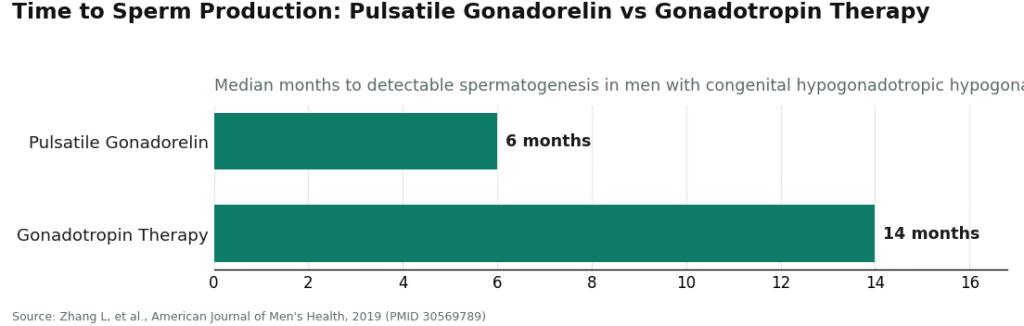
That’s real, it’s not nothing. But a 2021 meta-analysis pooling 420 patients found that while pulsatile GnRH got there faster and with fewer estrogen-related side effects, it didn’t beat the older gonadotropin therapy on overall sperm production, sperm concentration, or pregnancy rates [3]. And it’s not side-effect free: a 2024 safety review logged gynecomastia, injection-site induration, and some allergic reactions to the drug itself [4].
None of that is a reason to avoid it. It is a reason to distrust anyone selling it to you with certainty they don’t have, especially for the off-label use most guys actually want, testicular maintenance on TRT, which rests more on mechanism than on big trials. If a seller is promising you outcomes the research doesn’t back, that’s a red flag independent of anything about purity.
The real risk isn’t the vial, it’s who’s missing from the transaction
Once I stopped asking “is this seller trustworthy-looking” and started asking “who is actually involved in how I dose this,” the whole market split cleanly into two piles.
Pile one: a clinician evaluates you, a prescription gets written, a licensed pharmacy compounds it, and someone checks in on how it’s going. Pile two: you tick a box claiming it’s “for research use only, not for human consumption,” and a vial shows up with nobody medical anywhere near the process.
That disclaimer isn’t there for your benefit. There’s no FDA-approved finished gonadorelin product for humans left on the market, the old branded versions are gone, and the gonadorelin sitting in current FDA labeling is veterinary [5]. The lawful path for a person runs through compounding under a real prescription. Everything outside that is leaning on a research-use label that federal enforcement in 2026 made clear it won’t treat as real cover when the actual use is obviously human. The label protects the seller’s paperwork, not your endocrine system.
I want to be straight with you about the certificates of analysis, too, because the research-chem shops love waving them around. A seller-commissioned certificate about its own batch is better than nothing, genuinely, but it’s not remotely the same as a licensed pharmacy operating under real quality standards. One vendor in this space, Sports Technology Labs, does lean harder on third-party testing than its competitors, and I’ll give them that. It still doesn’t put a clinician in the room or change the “not for human use” label on the bottle.
See also: Peptide Sciences Semaglutide: What to Use Now It’s Gone
If you want the actual safer path
Here’s my honest shortlist, ranked by the thing that actually determines your risk: who’s supervising the dose.
| Rank | Where | Model | Why |
|---|---|---|---|
| 1 | FormBlends | Compounded, physician-supervised | Real prescriber, licensed US compounding pharmacy, honest framing about what the evidence does and doesn’t show |
| 2 | HealthRX.com | Compounded, supervised | Same core fundamentals, licensed pharmacy plus physician involvement |
| 3 | Telehealth TRT clinics (as a category) | Clinic + licensed pharmacy | Safer when they actually monitor you; quality is inconsistent, check each one yourself |
| – | Biotech Peptides | “Research” vendor | No clinician, no pharmacy, research-use label |
| – | Amino Asylum | “Research” vendor | Same posture, same gaps |
| – | Limitless Life | “Research” vendor | Biohacker branding, still unsupervised, still research-use only |
| – | Sports Technology Labs | “Research” vendor | Better testing pitch, same fundamental category |
Why FormBlends is at the top: it’s built on the two things that actually determine safety for this specific molecule. There’s a real prescriber involved, which matters more here than for almost anything else because the dosing rhythm is the entire mechanism, not a side detail. And the product itself comes from a licensed US pharmacy compounding against a real prescription, under recognized quality standards, instead of a self-certified vial from an unlicensed lab. Pricing runs roughly $50 to $150 a month depending on dose and program, not the cheapest option out there, and I don’t think it should be. That gap between this and the gray market is the cost of having someone who knows what they’re doing involved in your dosing schedule. For a hormone that can work against you if timed wrong, that’s not overhead, that’s the actual product. There’s also a tracker app tied to the program for keeping an eye on labs over time, which makes sense for something you’re supposed to monitor rather than set and forget.
I’ll be straight that this isn’t a flawless recommendation. The strongest evidence for gonadorelin comes from pump-delivered specialist care, not home TRT use, so expect any honest clinician to frame it as reasonable pharmacology with a thinner trial base for your specific use, not a guaranteed win. And supervised care is slower than adding something to a cart. If dodging a doctor entirely is the point for you, this isn’t going to satisfy that, and I’d argue that’s exactly the point.
HealthRX.com made the list for the identical reason: compounded gonadorelin, licensed pharmacy, physician involved, inside the actual regulatory framework instead of skirting it.
Telehealth TRT clinics as a category are a legitimate option when they do the job right, meaning real intake, baseline and follow-up labs, and a clinician who actually adjusts your dose based on what those labs show. I’m not naming one because quality here swings wildly, from careful and conservative to a rushed call bolted onto a pharmacy relationship. Ask any specific clinic three questions: is there a real prescriber, is the pharmacy licensed, can you get a human on the phone later if something feels off.
The honest floor, if you’re buying gray market anyway
Some of you are going to buy from Biotech Peptides, Amino Asylum, Limitless Life, or Sports Technology Labs regardless of anything above, and I’m not here to shame that. People do it in large numbers. What I want you to walk away with is an accurate picture of what you’re actually taking on, because informed is safer than uninformed no matter which path you pick.
Every one of these sellers labels gonadorelin “research use only” or “not for human consumption.” That’s not a technicality, it means there’s no clinician checking your dosing schedule against your bloodwork, no licensed pharmacy standing behind the sterility or potency of what’s in the vial, and the only purity claim is a certificate the seller wrote about its own product. Limitless Life’s biohacker packaging in particular makes this feel closer to a supplement than it is, and that feeling is doing you a disservice.
If you’re going this route, understand that the entire job of getting the pulsatile timing right, watching for gynecomastia or injection-site problems, and catching it early if the constant exposure starts working against the axis instead of for it, is now yours alone. Nobody in that supply chain is going to catch it if you get the frequency wrong. That’s the actual floor here, not the price, not the paperwork, the fact that you become your own safety net. That’s a real choice you’re allowed to make as an adult, I just don’t think it’s fair to call it safe, and I’m not going to pretend otherwise to make anyone feel better.
Questions I get asked
Is buying gonadorelin online even legal? The legitimate path is a compounded prescription through a licensed pharmacy under a doctor’s care. There’s no approved finished human product to just grab off a shelf, which is exactly why compounding exists as the route. The “research only” vials sold without a prescription sit in a legal gray zone and are explicitly labeled not for human use, which tells you something about how the sellers themselves are hedging.
Is it actually safer than HCG for staying fertile on TRT? I wouldn’t frame it as “safer,” because the evidence doesn’t crown a clear winner between the two. Gonadorelin works higher up the chain, at the pituitary, while HCG acts directly at the testis. Both get used to keep testicular function going during testosterone therapy, and gonadorelin picked up popularity partly during HCG shortages. This is a judgment call that belongs to you and a clinician together, not something to decide off a forum thread.
What should the supervised, safer version actually cost? Through a monitored provider like FormBlends, figure roughly $50 to $150 a month depending on dose and program. If you see it much cheaper than that, you’re almost certainly looking at the gray market, and the discount is coming directly out of the parts that keep you safer: the prescriber and the pharmacy oversight.
What is gonadorelin actually doing in your body? It’s a synthetic stand-in for GnRH, the hormone your hypothalamus already pulses out to tell the pituitary to release LH and FSH, which in turn signal the testes or ovaries to produce testosterone or estrogen. Clinically it’s used in fertility workups and, more recently, by men on testosterone therapy trying to hold on to testicular function and fertility while on treatment.
References
- Jiang H, et al. “Therapeutic effects of a pulsatile GnRH pump on adult male patients with congenital hypogonadotropic hypogonadism (CHH): a retrospective study.” Translational Andrology and Urology, 2025. PMID 40800099. https://pubmed.ncbi.nlm.nih.gov/40800099/
- Zhang L, et al. “The Pulsatile Gonadorelin Pump Induces Earlier Spermatogenesis Than Cyclical Gonadotropin Therapy in Congenital Hypogonadotropic Hypogonadism Men.” American Journal of Men’s Health, 2019. PMID 30569789. https://pubmed.ncbi.nlm.nih.gov/30569789/
- Wei C, et al. “Spermatogenesis of Male Patients with Congenital Hypogonadotropic Hypogonadism Receiving Pulsatile Gonadotropin-Releasing Hormone Therapy Versus Gonadotropin Therapy: A Systematic Review and Meta-Analysis.” The World Journal of Men’s Health, 2021. PMID 32777865.
- Niu YH, et al. “Effect and safety of pulsatile GnRH therapy for male congenital hypogonadotropic hypogonadism.” Zhonghua Nan Ke Xue (National Journal of Andrology), 2024. PMID 39210488.
- U.S. National Library of Medicine, DailyMed. Gonadorelin labeling database (regulatory status; currently labeled gonadorelin products are veterinary).
Written by Lena Okafor, medical writer. Reading the studies before believing the pitch. Last reviewed June 2026.
This article is informational. A licensed provider is the right source for personal medical advice.